


News

Custodial Torture at Slight Decrease: AF Torture Briefing

14 May 2013. In its torture briefing of July-Dec 2012, Advocacy Forum (AF) has analyzed the trends and patterns of torture practices in police detention facilities. The briefing has shown a slight reduction of torture percentage compared to that of the previous six months, i.e. Jan-June 2012; however, the prevalence of torture stands above the average percentage recorded by AF over the period of 2008-2010.
» more

AF Documentary Awarded

AF Documentary Awarded 16 April 2013. "The Last Message", a documentary produced by Advocacy Forum (AF), has been awarded with the highest prize on 14 April 2013 at Kathmandu Short Film Festival. Ganesh Pandey, director of the documentary and media officer at AF, received the award.
» more

Stay TRC Ordinance: SC

2 April 2013. Responding to two writ petitions filed separately on 24 March 2013, the Supreme Court (SC) of Nepal has issued a stay order yesterday asking the Chairman of Council of Minister not to form Truth and Reconciliation Commission under the recent TRC Ordinance which empowers the commission to grant amnesty even to those involved in serious human rights violations.
» more

The Observatory raises Serious Concerns over Physical Assaults and Threats to Human Rights Defenders in Nepal

7 March 2013. URGENT APPEAL - THE OBSERVATORY
The Observatory for the Protection of Human Rights Defenders, a joint programme of the World Organisation Against Torture (OMCT) and the International Federation for Human Rights (FIDH), requests your urgent intervention on the following situation in Nepal.
» more

Case Updates

Emblematic Cases

Among the hundreds of cases documented, Advocacy Forum has selected altogether 15 representative cases that show an endemic pattern of obstruction of justice, brazen abuse or total disregard of the law and deliberate attempts to escape accountability. The cases are also selected on the basis of their availability of evidence and wider public appeal. AF launches campaigns with other national and international organizations to establish accountability in those cases with a view to opening the door of justice to thousands of other similar cases.
» more

First Information Reports

First Information Report (FIR) is a formal complaint lodged with the police or District Administration Office by the victim of a cognizable offence or by someone on his/her behalf.  As per the existing legal system in Nepal, victims or their representatives do not have direct access to the courts. In criminal cases, police have exclusive jurisdiction to investigate and process evidence to the public prosecutors who then register the cases in court. However, the police authorities not only dillydally to register FIRs but also fail to carry out effective investigations. AF has been helping victims and their families to file FIRs and seeking mandamus orders for the effective investigations on the cases.
» more

Human Rights Committee Submissions

Advocacy Forum is the first organization in Nepal to use individual complaint mechanism under the First Optional Protocol of International Covenant for Civil and Political Rights (ICCPR). According to the said protocol, individuals, whose countries are party to the ICCPR and the protocol, who claim their rights guaranteed by the ICCPR have been breached, and who have exhausted existing domestic legal remedies in the pursuit of justice, can submit written communications to the UN Human Rights Committee (HRC). This particular effort of AF has opened the space of Nepali lawyers to international litigation.
» more

Torture Compensation Cases

Advocacy Forum legally intervenes on behalf of detainees who claimed to have been tortured by police and forest officers in government detention facilities. Upon consent by victims, AF attorneys register suits, and represent victims in court seeking for torture compensation under the Torture Compensation Act -1996 and necessary action against the perpetrators.
» more

Initiatives

Case Communication

Advocacy Forum reports urgent cases of human rights violations to UN-OHCHR, AHRC and to some specific organizations such as Amnesty International, Asian Human Rights Commission, OMCT, Human Rights Watch, International Commission of Jurists, diplomatic communities, UN Special Rapporteur on Torture, the UN Special Rapporteur on Extrajudicial, Summary or Arbitrary Execution and the UN Working Group on Enforced and Involuntary Disappearances. These international organizations/bodies give due importance to our communications and have been regularly issuing urgent appeals to pressure the concerned authorities and the government. AF also regularly reports cases to Human Rights Cell of Nepal Police, Office of Attorney General and National Human Rights Commission requesting investigation and necessary action against the perpetrators and timely redress to victims.

Setting the Precedents

Important judicial rulings by courts in the cases represented by AF on behalf of victims have been instrumental in establishing case law in Nepal. The efforts of AF have been immensely important in setting standards vis-à-vis the cases of human rights violations and ensuring fair trial standards in Nepal and thereby creating a solid body of jurisprudence.  AF also files Public Interest Litigation (PIL) seeking various directive orders for the implementation of existing legal provisions and challenging those provisions that expressly contradict with the accepted international standards.


Capacity Building Measures

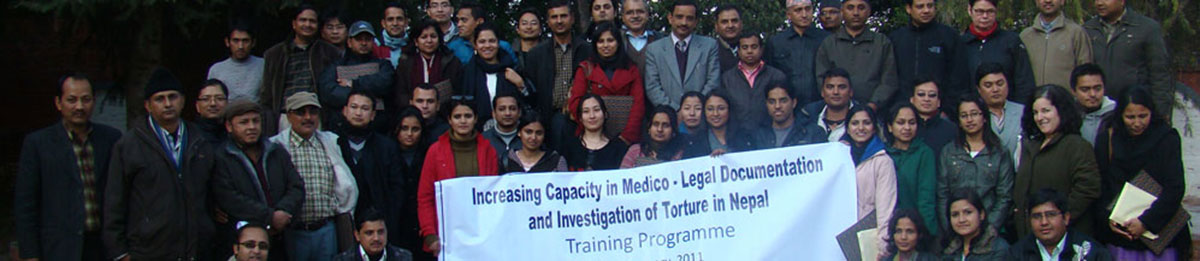
AF has developed a comprehensive framework to strengthen capacities of its staffers, stakeholders, institutions, communities and target groups for the effective realization of its vision, mission and goals. The framework is set at the systemic, institutional and individual levels.  Key areas that require capacity building are identified as per the needs of relevant stakeholders or when AF feels necessary during the implementation of its various activities. AF is also committed to increasing its functionality by supplementing the expertise of staff wherever possible, both by educational workshops and by exposure to the international human rights community.

Advocacy and Lobbying

Advocacy Forum works to influence the Nepali government's policies and laws by holding regular lobby meetings with lawmakers, officials from ministries concerned, members of the civil society and other relevant stakeholders. Via various activities, campaigns and submissions, it also tries to lobby both national and international bodies to ensure human rights are upheld. It has also been continuously seeking to establish strong lines of communication and effective working partnerships with the international and domestic human rights community. AF recognizes the necessity of international co-operation in overturning the culture of impunity that sustains a climate conducive to human rights abuse in Nepal.